
Concrete Roof vs Metal Roof: Which Roof Waterproofing System Fits
Concrete roofs leak from ponding water, metal roofs leak at laps and screws — here is the right system for each, with real Malaysian price ranges.
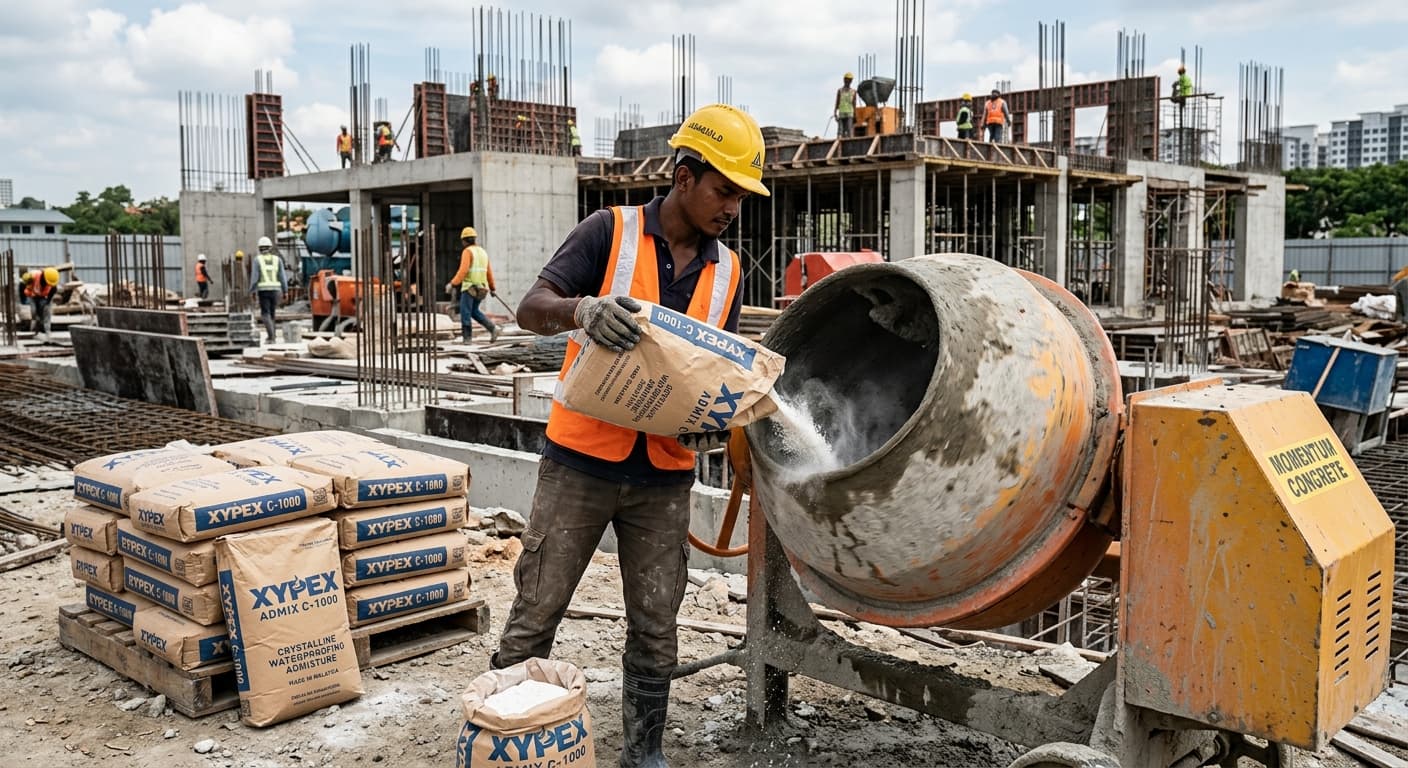
Concrete roofs and metal roofs leak for completely different reasons, so the same treatment cannot be used on both. A concrete roof needs a continuous waterproofing layer that survives ponding water and hairline cracks; a metal roof needs its laps, screws and flashing treated — not its whole surface. Get this wrong and you pay twice: once for the original job, and again to open it up within two monsoon seasons.
Here is the honest difference between the two, including where each system genuinely fails.
The basic difference: concrete absorbs, metal moves
Concrete is porous. Even when your slab looks dense and dry, rainwater finds its way in through fine pores, hairline cracks and the junction between the slab and the parapet wall. The job of waterproofing here is to form one unbroken layer across the whole surface.
Metal is already watertight. The zincalume sheet or metal deck itself absorbs nothing. What leaks is every place two things meet — the lap between two sheets, the screw holes, the flashing against a neighbour's roof, and the line where the roof meets a wall.
Concrete roofs: water that never gets to drain
Most flat slabs in Malaysia are built with too little fall. When the slope is shallower than 1:100, heavy monsoon rain sits on the roof for hours after the rain stops. That standing water is what hunts for the weak spot in your waterproofing.
That is why on a concrete roof we almost always talk about fall and outlets before we talk about materials. If the screed slope is wrong, no membrane or coating will last.
Metal roofs: thermal movement
A six-metre metal sheet can expand and contract a few millimetres every single day, especially when a 35°C afternoon is followed by an evening downpour. That repeated movement works screws loose, tears hardened EPDM washers, and splits any sealant that is not elastic.
Which means a metal roof treatment must stay flexible for life. Anything that hardens and goes brittle will crack again in the same spot within a year or two.
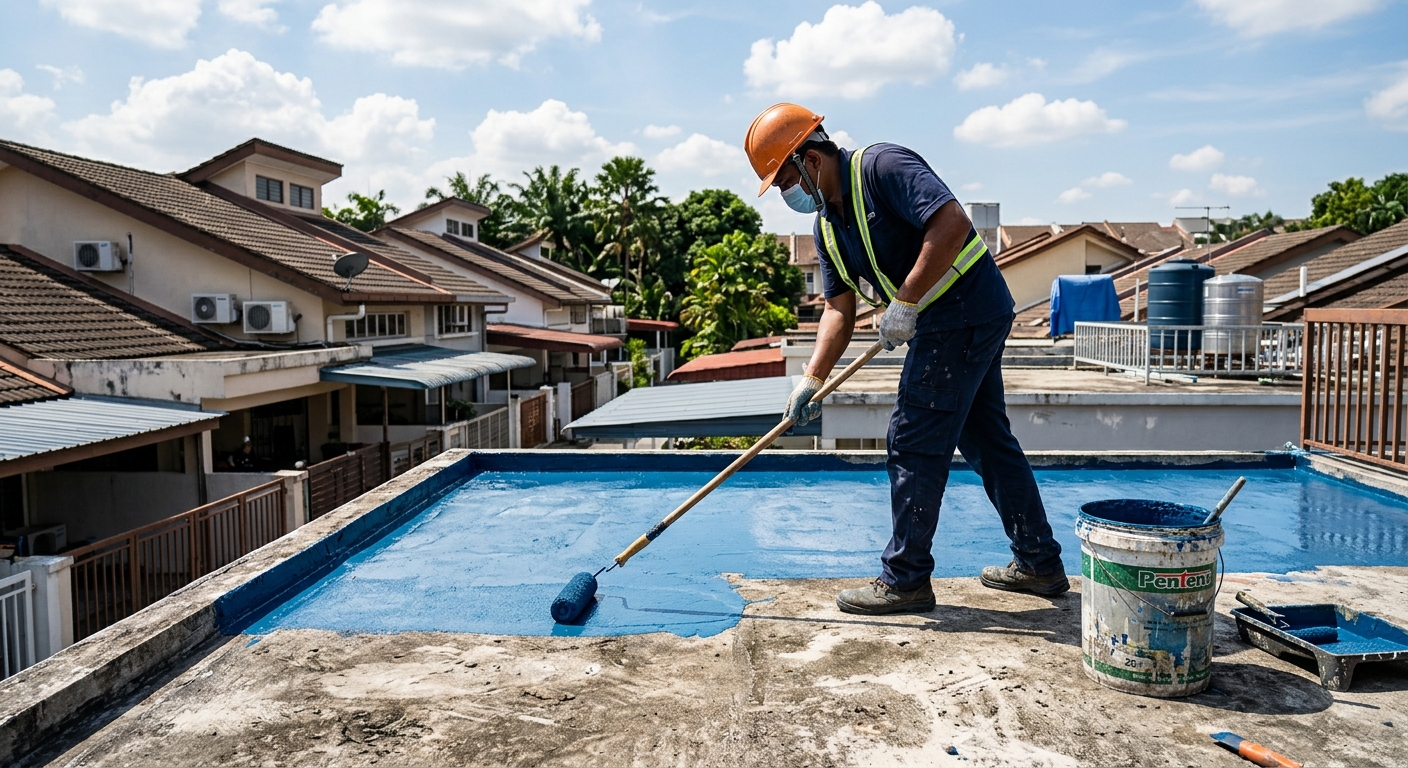
Roof waterproofing systems for concrete
For concrete slabs there are three families of system we actually use on site. Which one fits depends on the condition of the slab and whether anyone will walk on the roof.
Cementitious slurry — cheapest, stiffest
Modified cement slurry is brushed on in two or three coats, usually with fibreglass mesh at the corners. It bonds well to damp concrete and can be screeded over afterwards.
Its weakness is obvious: it is rigid. If your slab has cracks that are still moving, the slurry will crack along them. It suits stable slabs and bathrooms, not a roof that is already showing structural cracks.
Torch-on membrane — for large slabs and ponding
A 3mm or 4mm bitumen membrane is torched onto a primed deck. This is the most honest system for large slabs that pond regularly, because its thickness is consistent and it does not depend on an applicator's hand to reach the right build.
Its weak point is the laps and the upstand at the parapet. The upstand must run at least 150mm–200mm up the wall and terminate into a groove or under flashing. Nine out of ten membrane leaks we open up start at an edge, not in the field.
PU coating — for complicated shapes
Liquid polyurethane is rolled or brushed into a single seamless layer. It earns its keep when your roof is full of pipes, brackets and corners that are impossible to dress neatly in sheet membrane.
But PU demands a genuinely dry, clean substrate, and its final thickness depends on applicator discipline. A coating spread too thin to save material will chalk and fail within three years.
Metal roofs: laps, screws and flashing
On a metal roof our goal is not to blanket the whole surface. Coating healthy metal end to end usually wastes money and hides rust that is quietly progressing underneath.
Fix the screws first, not last
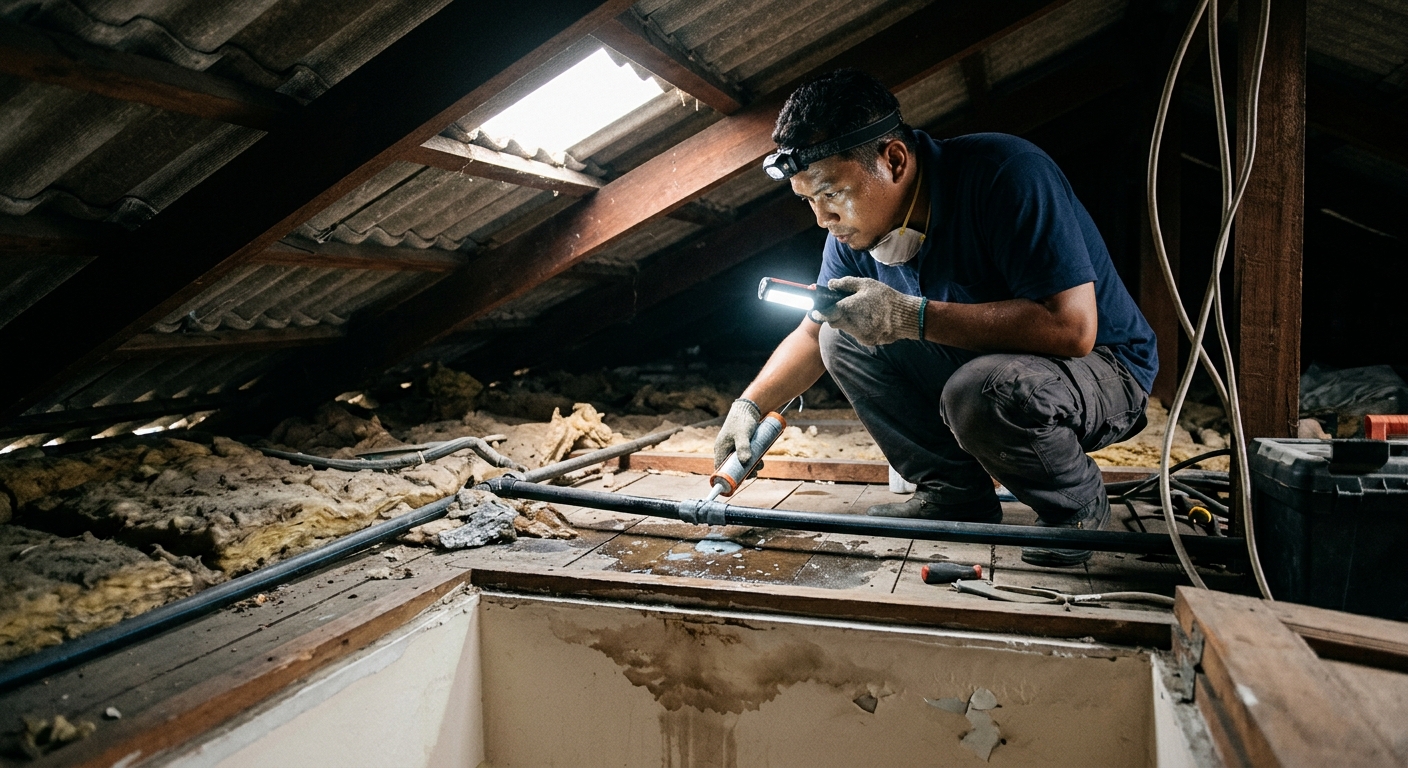
Old roofing screws with hardened rubber washers are the number-one leak source on factories, awnings and kitchen extensions. The fix is usually oversize replacement screws with fresh EPDM washers — not a blob of sealant squirted over the old heads.
Laps and flashing
For lap lines and flashing we use butyl tape or a polyurethane/MS polymer sealant, then on bad cases a polyester-mesh-reinforced acrylic band across the joint. That band stays flexible, so it can absorb thermal movement without splitting.
Ordinary silicone is not the right choice here. It cannot be painted over, it weakens under long-term UV, and nothing bonds to it later when other repairs are needed on top.
If it has rusted through, waterproofing is not the answer
This is the part clients least want to hear. Once sheets have rusted to pinholes and feel paper-thin, no coating saves them — the rust keeps travelling under the new layer. At that point the correct job is sheet replacement.
Cost of concrete vs metal roof waterproofing
The ranges below are Klang Valley market rates for work done with proper surface preparation. A real quote only comes after we climb up and measure — area, access and the condition of the old system move the number a lot.
- Cementitious slurry on a concrete slab: RM8–RM15 per square foot
- Torch-on membrane, 3–4mm: RM12–RM22 per square foot
- PU coating (full system, not one thin coat): RM15–RM28 per square foot
- Metal roof lap and screw treatment: RM6–RM14 per square foot of treated area
- Replacing rusted metal sheets: RM14–RM30 per square foot including labour
Notice that metal roofs are usually cheaper to treat, because we only touch a small part of the area. But once sheets need replacing, the cost overtakes concrete work. There is a fuller breakdown in our roof waterproofing cost guide.
The mistakes we see most often
These four things explain almost every re-do job that reaches us from another contractor.
Coating spread over a moving crack
A live structural crack has to be opened out, filled and banded with a flexible reinforced detail first. Coating straight over a moving crack splits along the same line, usually before the second monsoon.
Parapet upstands that are too low
A membrane terminated only 50mm up the wall gets overtopped whenever wind drives the rain. Water gets behind the membrane, and the damp patch appears far from where it entered — which is exactly why it is so hard to trace.
Paint over rust
Roof paint is not waterproofing, and it does not stop rust that has already started underneath. It buys a few months while hiding the true state of the sheets.
Outlets and gutters left uncleaned
Even perfect waterproofing fails if the water has nowhere to go. Leaves, nests and leftover cement in the outlet turn your roof into a pond. The early warning signs are in our list of signs your roof needs waterproofing.
How to choose the right treatment
This is the shortlist we work from when making a recommendation on site:
- Large flat concrete slab that ponds often — torch-on membrane, with the screed fall corrected first.
- Small concrete slab with many pipes and corners — PU coating, because it is seamless.
- Stable concrete roof, tight budget, no foot traffic — cementitious slurry with mesh at corners.
- Metal roof still structurally sound — treat the screws, laps and flashing only.
- Metal roof rusted through — replace the sheets; do not pay for coating.
If you are not sure which category your roof falls into, that is normal — plenty of terrace houses in Cheras and apartments around KLCC have both types at once, concrete over the main structure and metal over the rear extension.
WhatsApp us photos of your roof for a first opinion, or book a site inspection so we can climb up, measure and tell you straight which system fits — including if the answer is that you do not need to spend anything on it this year.